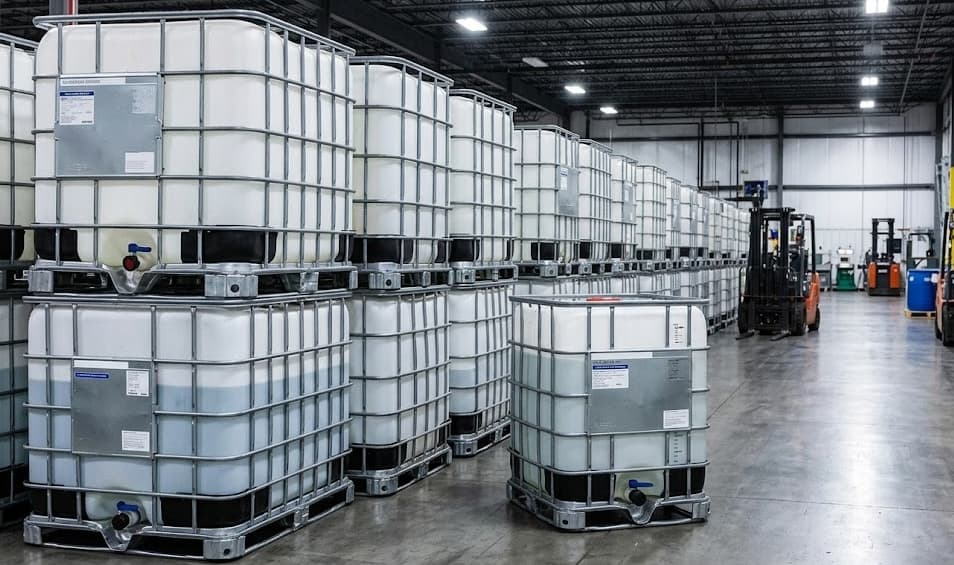
Our Sustainability Mission
Sustainability is not a department at IBC Totes Recycle — it is our entire reason for existing. Every process, investment, and partnership is measured against its environmental impact.
Get a Free Quote
Closing the Loop on Industrial Containers
The intermediate bulk container industry generates an enormous material footprint. An estimated 30 million IBC totes are manufactured globally each year, and in the United States alone, roughly 4 million reach end-of-first-use annually. Without intervention, most of these containers — each weighing between 55 and 75 kg of HDPE plastic and steel — end up in landfills or low-value scrap streams after a single use.
At IBC Totes Recycle, we intervene at every stage of the container lifecycle. We collect used totes before they reach the waste stream. We inspect and recondition containers that still have structural integrity. We recycle components that have reached true end-of-life into raw materials for new products. And we do all of this with the lowest possible energy, water, and carbon footprint our engineering team can achieve.
This page outlines our four sustainability pillars, our concrete targets for the years ahead, and the partnerships that help us deliver on these commitments. We publish these figures because we believe transparency is the foundation of trust — and accountability is the engine of progress.
Four Pillars of Sustainability
Every operational decision we make is evaluated against these four pillars. They are not aspirations — they are standards we hold ourselves to daily.
99.6%
Diversion Rate
Zero Waste to Landfill
We achieved zero-waste-to-landfill certification in 2018 and have maintained it every year since. Every component of an IBC tote — the HDPE bottle, steel cage, wooden or plastic pallet, gaskets, valves, and labels — enters a dedicated recycling or reuse stream. End-of-life HDPE is granulated and sold to manufacturers of drainage pipe, lumber alternatives, and agricultural containers. Steel cages are baled and sent to electric arc furnace mills. Even wash water residues are treated and the recovered solids are processed for energy recovery.
75%
Lower CO2 vs. New Production
Carbon Reduction
Manufacturing a new 275-gallon IBC tote from virgin materials generates approximately 33 kg of CO2 equivalent. Reconditioning an existing tote in our facility produces roughly 8 kg — a 75% reduction. Across our annual throughput of over 150,000 totes, that translates to nearly 3,750 metric tons of CO2 prevented every year. We have committed to reducing our own operational emissions by 50% by 2030 (against a 2020 baseline) through fleet electrification, rooftop solar expansion, and procurement of renewable energy certificates for remaining grid electricity.
80%
Water Recycled Per Wash Cycle
Water Conservation
Our closed-loop wash systems capture, filter, and recirculate up to 80% of the water used in each cleaning cycle. Triple-stage filtration — coarse screening, activated carbon, and UV sterilization — ensures that recycled water meets the same cleanliness standards as fresh supply. Compared to single-pass manual washing, our systems use approximately 15 gallons per tote versus 75 gallons, saving over 9 million gallons annually. We also harvest rainwater from our facility rooftops for non-critical wash pre-rinse stages.
340kW
Rooftop Solar Capacity
Energy Efficiency
Our South Milwaukee facility generates approximately 40% of its electricity from a 340 kW rooftop solar array installed in 2020. High-efficiency variable-speed drives on our wash pumps reduce electricity consumption by 25% compared to fixed-speed systems. LED lighting throughout all warehouses and offices, coupled with occupancy sensors and daylight harvesting controls, cut lighting energy by 60%. Our goal is to reach 100% renewable electricity by 2028.
Our Carbon Footprint Report
We believe that measuring emissions is the first step to reducing them. Here is a detailed breakdown of our annual operational carbon footprint by category, based on our most recent full-year data.
Total Operational Emissions
Scope 1 + Scope 2 + Partial Scope 3
535
Metric Tons CO2e per Year
Transportation & Logistics
Emissions from our company-owned fleet and contracted carriers for tote pickup and delivery. Fleet electrification will reduce this by 40% by 2030.
Facility Energy (Grid)
Grid electricity consumption for wash pumps, lighting, compressed air, and office operations. Our 340 kW solar array already offsets 40% of this; the 2028 target is 100% renewable.
Wash Process (Heating)
Natural gas used to heat wash water to required temperatures. We are evaluating heat-pump and solar-thermal alternatives for a 2027 pilot program.
Material Processing
Energy used for HDPE granulation, steel baling, and pallet chipping operations. Variable-frequency drives on grinders reduced this by 18% in 2023.
Employee Commuting
Estimated Scope 3 emissions from staff travel. We offer EV charging stations at our facility and subsidize public transit passes for all employees.
Consumables & Maintenance
Replacement gaskets, valves, cleaning chemicals, PPE, and facility maintenance materials. We source recycled-content consumables wherever available.
For context: our 535 metric tons of operational emissions are offset many times over by the 3,925 metric tons of CO2 we prevent annually by reconditioning totes instead of manufacturing new ones.
Net impact: approximately 3,390 metric tons of CO2 avoided per year.
Water Stewardship
Water is the lifeblood of our reconditioning process, and we treat it with the respect it deserves. Our closed-loop wash system recovers 80% of every wash cycle, and our goal is to reach 90% by 2027. Here is a detailed look at how water moves through our facility — from initial use to recirculation or permitted discharge.
The average IBC tote reconditioning consumes just 15 gallons of water in our system, compared to 75 gallons in a single-pass manual wash. Across our annual throughput of 157,000 totes, that difference adds up to over 9.4 million gallons saved per year. Rainwater harvesting from our 60,000 sq ft rooftop supplements non-critical pre-rinse stages, further reducing municipal water demand.
All discharge water is treated to exceed Milwaukee Metropolitan Sewerage District standards. Quarterly third-party laboratory testing confirms that every parameter — pH, biological oxygen demand (BOD), total suspended solids (TSS), and metals — meets or exceeds permit limits. We have maintained a perfect compliance record since our WPDES permit was issued.
Collection & Pre-Screening
Used wash water flows through coarse screens that remove large particulates — label fragments, gasket remnants, and sediment — before entering the treatment cycle.
Chemical Treatment
pH adjustment and flocculation settle dissolved solids and emulsified oils. Settled sludge is dewatered and sent for energy recovery at a licensed facility.
Activated Carbon Filtration
Water passes through granular activated carbon beds that adsorb organic compounds, residual surfactants, and trace chemical contaminants.
UV Sterilization
Ultraviolet light at 254 nm wavelength destroys bacteria, viruses, and other microorganisms without adding chemical disinfectants to the water stream.
Quality Verification
Automated sensors continuously monitor pH, turbidity, total dissolved solids (TDS), and temperature. Water that meets recirculation standards is returned to the wash line.
Permitted Discharge
The 20% of water not recirculated is treated to exceed MMSD discharge standards and released under our active WPDES permit. Third-party testing validates compliance quarterly.
Circular Economy Explained
The circular economy is an alternative to the traditional “take, make, dispose” linear model. Here is how it works in the context of IBC totes — and why it matters.
The Linear Model (Traditional)
In the linear economy, raw materials are extracted, manufactured into products, used once or a few times, and then discarded as waste. For IBC totes, this means virgin HDPE resin is polymerized, blow-molded into a bottle, assembled with a new steel cage and pallet, shipped to a customer, used to store and transport one batch of product, and then sent to a landfill. The total material cost to the environment: approximately 55-75 kg of plastic and steel, 33 kg of CO2, 180 gallons of manufacturing water, and 520 MJ of energy — all for a single use.
The Circular Model (Our Approach)
In the circular economy, products are designed and managed to stay in productive use for as long as possible. For IBC totes, this means collecting used containers after their first use, inspecting them for structural integrity, cleaning and reconditioning them, replacing worn gaskets and valves, and selling them back into the supply chain for a second, third, fourth, or even fifth use cycle. When a tote finally reaches true end-of-life, every component is disassembled and recycled into raw materials for new products. The landfill receives nothing.
Why It Matters for Your Business
Circular economy practices reduce your procurement costs by 40-80%, lower your supply chain carbon footprint, generate verifiable ESG data for sustainability reporting, and reduce your exposure to volatile virgin material markets. When you buy reconditioned totes or sell your used containers back into the reconditioning supply chain, you are actively participating in the circular economy — creating financial value while eliminating waste.
The Numbers
3-5x
Lifecycle Extensions Per Tote
75%
CO2 Reduction Per Cycle
99.6%
Material Recovery Rate
40-80%
Cost Savings vs. New
Supply Chain Sustainability
Sustainability does not stop at our facility doors. We work to reduce environmental impact across our entire supply chain — from the chemicals we use in cleaning to the carriers who transport our totes.
Green Chemistry
Our cleaning detergents are biodegradable, phosphate-free, and VOC-compliant. We work with chemical suppliers who meet EPA Safer Choice criteria wherever possible, ensuring that our wash process does not introduce harmful substances into the water stream.
Route Optimization
Our proprietary logistics software optimizes pickup and delivery routes to minimize total miles driven, fuel consumed, and emissions generated per tote. Route optimization has reduced our fleet fuel consumption by 30% since implementation in 2019.
Carrier Standards
Third-party carriers in our logistics network are evaluated on environmental criteria including fleet age, fuel efficiency, idle-reduction technology, and emissions reporting. We preferentially contract with carriers who demonstrate measurable sustainability commitments.
Packaging Elimination
IBC totes are inherently packaging-efficient — they require no secondary packaging for transport. Unlike drums that need pallets, stretch wrap, and slip sheets, totes ship as-is on their built-in pallets, eliminating thousands of pounds of packaging waste annually.
Consumable Sourcing
Replacement gaskets, valves, and labels are sourced from suppliers who use recycled content and maintain their own environmental management systems. Our procurement policy requires environmental data sheets from all consumable vendors.
Customer Education
We provide customers with best-practice guides on tote handling, residual product recovery, and end-of-use logistics to ensure containers arrive at our facility in the best possible condition for reconditioning — maximizing lifecycle extensions and reducing waste.
The Environmental Math of Reconditioning vs. New
A full lifecycle assessment (LCA) of IBC tote production versus reconditioning reveals dramatic differences across every environmental metric. Here is what the data shows for a standard 275-gallon composite IBC tote:
Raw Material Extraction
New Production
~45 kg virgin HDPE + steel
Reconditioning
Replacement gaskets and valve only (~0.3 kg)
99% material savings
Energy Consumption
New Production
~520 MJ per tote
Reconditioning
~85 MJ per tote
84% energy reduction
Water Usage
New Production
~180 gallons (cooling + processing)
Reconditioning
~15 gallons (closed-loop wash)
92% water reduction
CO2 Equivalent
New Production
~33 kg CO2e
Reconditioning
~8 kg CO2e
75% carbon reduction
Annual Environmental Impact
Based on our 2024 throughput of 157,000 totes
CO2 emissions prevented
Water saved vs. new manufacturing
Plastic diverted from landfill
Energy avoided
Every reconditioned tote prevents the equivalent of driving a car 80 miles.
Based on EPA average passenger vehicle emissions of 404 g CO2/mile
Environmental Metrics Dashboard
We track over 30 environmental KPIs across our operations. Here are the metrics that matter most — updated to reflect our most recent full-year performance data.
99.6%
Landfill Diversion Rate
80%
Water Recycling Rate
40%
Electricity from Solar
75%
CO2 Reduction vs. New
15 gal
Water Per Tote (vs. 75 gal)
8 kg
CO2e Per Reconditioned Tote
9.4M gal
Annual Water Saved
3,925 t
Annual CO2 Prevented
157,000
Totes Processed Annually
6,750 t
Plastic Diverted from Landfill
340 kW
Solar Array Capacity
535 t
Own Operational Emissions
30%
Fuel Reduction from Route Optimization
0
WPDES Permit Violations
4,800+
Community Volunteer Hours
200+
Totes Donated to Community
Third-Party Certifications
Our environmental claims are backed by independent verification, regulatory permits, and third-party certifications. Here is the complete list of our current credentials.
Zero Waste to Landfill
Independently certified since 2018 with a 99.6% diversion rate. Audited annually by a third-party environmental consulting firm reviewing waste manifests, recycling records, and facility operations.
Active — Renewed Annually
WPDES Discharge Permit
Wisconsin Pollutant Discharge Elimination System permit for treated wash-water discharge. Quarterly third-party laboratory testing confirms all parameters (pH, BOD, TSS, metals) meet or exceed permit limits.
Active — Quarterly Testing
DOT Hazardous Materials Compliance
All tote handling, transport, and reconditioning operations comply with DOT 49 CFR requirements. Team members maintain current HAZMAT handler certifications with annual renewals.
Active — Annual Renewal
ISO 14001 Environmental Management (Aligned)
Our environmental management system follows the ISO 14001 framework for continuous improvement, including documented procedures, internal audits, management reviews, and corrective action protocols.
Framework Aligned
EPA WasteWise Partner
Recognized by the U.S. Environmental Protection Agency WasteWise program for outstanding waste prevention, recycling, and buying recycled-content products in the industrial container sector.
Active Partner
SQF-Compatible Container Handling
Our food-grade reconditioning line meets Safe Quality Food program requirements for container cleaning, inspection, and handling — enabling customers in the food and beverage sector to maintain SQF certification.
Process Certified
Our Sustainability Targets
We set measurable, time-bound targets and report on them publicly. Here are the commitments we are working toward right now.
100%
Renewable electricity for all facilities by 2028
50%
Reduction in operational CO2 emissions by 2030 (vs. 2020)
Zero
Hazardous waste discharged to municipal systems — ever
90%
Water recycling rate target by 2027 (currently 80%)
100%
Fleet vehicles electric or biodiesel by 2032
10,000+
Community volunteer hours contributed annually by 2027
Future Goals 2025 - 2030
Our sustainability journey is far from over. Here is a phase-by-phase roadmap of what we are working toward over the next five years — with specific, measurable milestones at each stage.
- •Complete Phase 1 fleet electrification — 6 electric flatbed trucks operational
- •Launch heat-pump pilot program to replace natural gas for wash-water heating
- •Achieve 85% water recycling rate (up from 80%)
- •Begin publishing annual sustainability report publicly on our website
- •Install second rainwater harvesting system for expanded pre-rinse capacity
- •Reach 90% water recycling rate across all wash lines
- •Achieve 10,000+ community volunteer hours contributed annually
- •Complete rooftop solar expansion to 500 kW capacity
- •Deploy real-time environmental dashboard accessible to all employees
- •Launch customer-facing sustainability portal with order-level impact tracking
- •Reach 100% renewable electricity for all facilities
- •Eliminate natural gas from wash operations (full heat-pump conversion)
- •Achieve 95% water recycling rate
- •Introduce carbon-neutral shipping option for all orders
- •Achieve 50% reduction in operational CO2 emissions vs. 2020 baseline
- •Reach 99.8% landfill diversion rate
- •Complete Phase 2 fleet electrification — 100% electric or biodiesel fleet
- •Establish industry-first IBC tote lifecycle tracking system using digital product passports
- •Open second reconditioning facility to reduce average shipping distance by 30%
Sustainability FAQ
Common questions about our environmental practices, certifications, and how our services support your sustainability goals.
How do you measure your environmental impact?
We track over 30 environmental KPIs monthly, including landfill diversion rate, CO2 emissions per tote processed, water consumption per tote, energy intensity (kWh per tote), and waste-stream composition. These metrics are compiled into an annual sustainability report reviewed by our leadership team and shared with key customers. We also provide order-specific environmental impact certificates that document the CO2 prevented, water saved, and material diverted for each transaction.
Are your environmental claims independently verified?
Yes. Our zero-waste-to-landfill certification is audited annually by an independent environmental consulting firm. Our water discharge meets WPDES permit requirements verified through quarterly third-party laboratory testing conducted in partnership with the Milwaukee Metropolitan Sewerage District. Solar generation data is monitored by our array installer and independently verified against utility meter readings.
What happens to totes that cannot be reconditioned?
Totes that fail our 15-point inspection are fully disassembled. HDPE bottles are granulated into pellets and sold to manufacturers of drainage pipe, composite lumber, and agricultural containers. Steel cages are baled and shipped to electric arc furnace mills for recycling. Wooden pallets are chipped for biomass energy or sent to pallet refurbishment operations. Gaskets, valves, and small components enter dedicated recycling streams. Our landfill diversion rate for these materials is 99.6%.
How does buying reconditioned totes help my company's ESG goals?
Every reconditioned tote you purchase prevents approximately 33 kg of CO2 from entering the atmosphere, diverts 55-75 kg of material from landfill, and conserves roughly 165 gallons of water compared to manufacturing a new container. We provide environmental impact certificates with every order that include these calculations specific to your purchase, giving your ESG and sustainability teams verifiable data for reporting frameworks like GRI, CDP, and TCFD.
Do you offer sustainability consulting for large-volume customers?
Yes. For customers purchasing or recycling more than 500 totes per year, we offer a complimentary sustainability review of your container lifecycle. Our environmental team analyzes your current tote procurement, usage, and disposal patterns and provides recommendations to reduce cost, waste, and carbon emissions. Many customers discover savings of 40-60% versus their current approach.
What are your plans for fleet electrification?
We began phased fleet electrification in 2025, starting with three electric flatbed trucks for local and regional routes. Our target is 100% electric or biodiesel vehicles by 2032. In the interim, we are optimizing route planning using logistics software that has already reduced fuel consumption by 30%, and we prioritize consolidated loads to minimize total miles driven per tote delivered.
We Do Not Do This Alone
Meaningful environmental progress requires collaboration. Here are the organizations we partner with to amplify our impact.
Wisconsin Department of Natural Resources
Regulatory compliance partner and co-sponsor of the Wisconsin Circular Economy Initiative, which promotes industrial material reuse across the state.
National Association for PET Container Resources (NAPCOR)
Knowledge-sharing on HDPE and PET recycling best practices, end-market development for recycled plastics, and industry-wide contamination reduction programs.
The Recycling Partnership
Member organization contributing to infrastructure grants, municipal recycling system improvements, and public education campaigns on industrial container recycling.
Milwaukee Metropolitan Sewerage District (MMSD)
Joint water quality monitoring program ensuring our wash water treatment exceeds all discharge permit requirements. Annual third-party audits confirm compliance.
Local Schools Environmental Education Program
We host field trips and educational workshops for middle and high school students across the greater Milwaukee area, teaching the practical economics and science of industrial recycling.
Sustainability Starts With Your Next Tote
Every reconditioned IBC tote you buy or every used tote you sell back to us keeps materials in productive circulation and out of the landfill. Join the circular economy today.