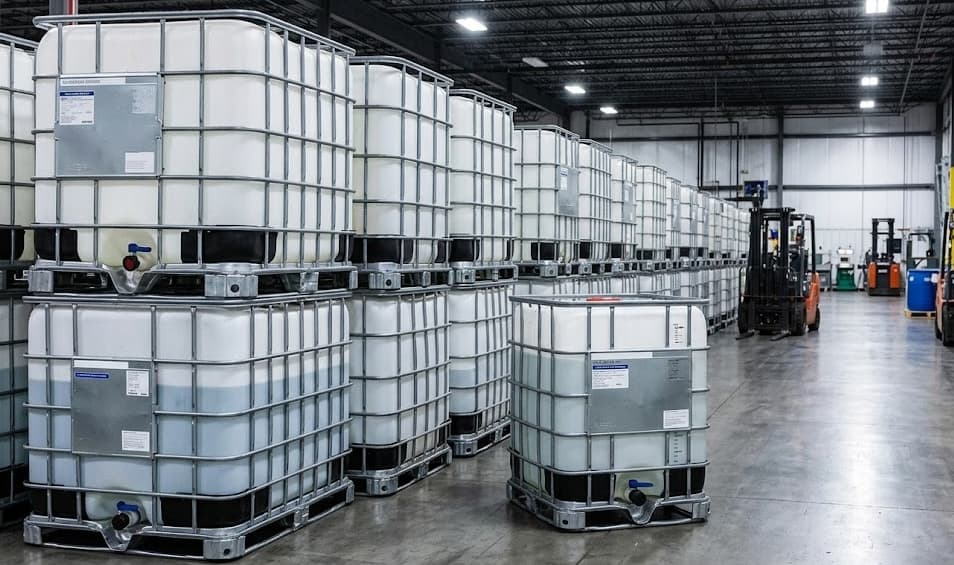
IBC Tote Cleaning & Reconditioning Services
Extend the useful life of your IBC totes by 3-5 additional cycles with our industrial-grade cleaning, repair, and certification process.
Get a Free Quote
Our 6-Step Washing & Reconditioning Process
Every IBC tote that enters our facility goes through a rigorous, standardized cleaning and reconditioning workflow. The result is a container that performs like new at a fraction of the cost.
Initial Inspection & Draining
Every tote is visually inspected and any remaining product is drained and collected for proper disposal or recovery. We document the incoming condition, previous contents, and any damage for our tracking system.
Pre-Rinse & Residue Removal
High-pressure jets at 1,200 PSI blast the interior to remove bulk residues, sediment, and film. Stubborn deposits are treated with food-safe or chemical-grade cleaning agents matched to the previous contents of each tote.
Triple-Wash Cycle
Our automated rotary wash system runs three consecutive cycles -- hot alkaline wash, acid neutralization, and sanitizing rinse -- to achieve thorough decontamination. Water temperature reaches 180 degrees Fahrenheit for maximum efficacy.
Exterior Cleaning & Cage Treatment
The steel cage frame is pressure-washed, de-rusted where needed, and inspected for structural integrity. Bent bars are straightened hydraulically, and severely corroded sections are replaced to meet our quality standards.
Valve & Gasket Replacement
All butterfly valves, cam-lock fittings, and gaskets are inspected. Worn or damaged components are replaced with new, food-grade-compatible parts. Caps and vented lids are also checked and swapped as needed.
Quality Inspection & Certification
Each reconditioned tote undergoes a 12-point quality inspection covering structural integrity, cleanliness, valve operation, and labeling. Totes that pass receive a date-stamped certification tag and are ready for dispatch.
Cleaning Methods by Residue Type
Not all residues are the same, and neither are our cleaning methods. We match the wash protocol to the specific type of previous contents for optimal results and safety.
Food-Grade Products
Syrups, oils, fruit concentrates, vinegar, sauces, flavorings
Hot alkaline wash (180F) with food-safe detergent, followed by citric acid rinse and potable water sanitization. Meets FDA 21 CFR and food-contact surface standards.
Totes are eligible for food-grade re-certification after cleaning.
Water-Based Chemicals
Detergents, water treatment chemicals, adhesives, latex, coolants
Alkaline pre-wash to break emulsions, high-pressure hot rinse, and neutralizing acid wash. Surfactant-matched cleaning agents ensure complete removal.
Most common residue type. Standard triple-wash achieves full decontamination.
Solvent-Based Chemicals
Glycols, alcohols, MEK, acetone, thinners, degreasing agents
Ventilated pre-rinse to manage VOC emissions, solvent-compatible detergent wash, triple hot-water rinse, and air-dry cycle in ventilated chamber.
Extended drying time required. Flash-point testing performed post-wash.
Petroleum & Oil Products
Motor oil, hydraulic fluid, lubricants, cutting oils, fuel additives
Hot alkaline degreasing wash at 200F, followed by high-pressure emulsification rinse and activated carbon filtration. Multiple wash cycles may be required.
Oil residue requires additional processing. Some totes may need double-wash.
Agricultural Products
Fertilizers, herbicides, pesticides, adjuvants, soil amendments
Triple-rinse decontamination per EPA container disposal guidelines. Alkaline wash followed by acid neutralization and verified residue-free rinse.
EPA triple-rinse procedure compliance documented. Suitable for ag reuse.
Pharmaceutical & Cosmetic
Active ingredients, excipients, fragrances, personal care compounds
cGMP-adjacent cleaning protocol with validated detergent system, TOC (Total Organic Carbon) residue testing, and documented cleaning verification.
Full traceability and batch-specific cleaning records provided.
Equipment & Technology
Our facilities are equipped with automated rotary washing stations, high-pressure jet systems, and closed-loop water recirculation technology. This combination delivers superior cleaning results while conserving resources.
Automated Rotary Washers
360-degree interior coverage ensures consistent cleaning across every surface, eliminating manual inconsistencies. Programmable wash cycles adjust duration and chemical concentration per residue type.
High-Pressure Jet Systems
1,200 PSI precision nozzles blast stubborn residues from corners, threads, and surface textures that lower-pressure systems miss. Adjustable spray patterns target specific areas.
Closed-Loop Water System
Our multi-stage filtration and recirculation system reduces fresh water consumption by 80% compared to single-pass methods. Particulate filters, oil skimmers, and chemical neutralization stages keep recirculated water clean.
Heat Recovery Units
Waste heat from the wash cycle is captured and reused to pre-heat incoming water, cutting energy consumption by 35%. Heat exchangers operate continuously during production hours.
Chemical Dosing Systems
Automated chemical dosing ensures precise detergent and sanitizer concentrations for each wash cycle. Reduces chemical waste and ensures consistent cleaning results across every tote.
Effluent Treatment Plant
All wastewater is treated on-site through pH adjustment, flocculation, settling, and filtration to meet or exceed local discharge standards. Solids are captured for proper disposal.
Water Conservation Impact
80%
Less Water Used
35%
Energy Reduction
180°F
Wash Temperature
1,200
PSI Jet Pressure
Our closed-loop water system recirculates and filters wash water through multiple cycles, dramatically reducing the volume of fresh water needed per tote. Combined with heat recovery, each wash uses approximately 15 gallons of fresh water versus 75 gallons in conventional open-loop systems.
Quality Assurance Testing
Every reconditioned tote undergoes a battery of tests before it leaves our facility. These tests verify cleanliness, structural integrity, and functional performance to ensure the tote is safe and ready for its next fill cycle.
Visual Cleanliness Inspection
Trained inspectors examine the interior and exterior under bright LED lighting for any visible residue, staining, or contamination. Both the bottle interior and valve threads are checked.
Chemical Residue Testing
Swab testing and conductivity measurement of rinse water verify that chemical residues are below acceptable thresholds. For food-grade totes, ATP bioluminescence testing confirms sanitary conditions.
Odor Assessment
Each tote is sealed after washing and opened by a trained assessor to check for residual odors. Any detectable odor results in an additional wash cycle before the tote can pass inspection.
Valve Leak Test
The discharge valve is closed, the tote is filled with water to a defined level, and left standing for a minimum period. Zero leakage from the valve, cap, or any fitting is required to pass.
Structural Integrity Check
The HDPE bottle is examined for cracks, warping, and UV degradation. The steel cage is checked for alignment, weld integrity, and corrosion. The pallet is tested for load-bearing capacity.
Dimensional & Stackability Verification
Tote dimensions are verified against manufacturer specifications to ensure proper stacking, racking, and palletization. Out-of-spec totes are repaired or downgraded.
12-Point Quality Inspection
No tote leaves our facility without passing every one of these checks. If a container fails any point, it is either repaired and re-inspected or routed to our recycling stream.
Water Treatment & Recycling System
Water is the most critical resource in IBC tote cleaning, and we treat it with the seriousness it deserves. Our closed-loop water management system is designed to minimize consumption, prevent pollution, and comply with the strictest discharge standards in the country.
Here is how our water system works, from intake to discharge:
Stage 1: Fresh Water Intake
Municipal water enters the system and is pre-heated using waste heat from previous wash cycles. Only 15 gallons of fresh water are needed per tote thanks to our recirculation system.
Stage 2: Wash Cycle Use
Water circulates through the rotary washer at 180F with cleaning agents. After each cycle, water is captured in collection tanks rather than being discharged.
Stage 3: Particulate Filtration
Collected water passes through multi-stage filters that remove solid particles, sediment, and debris down to 5-micron size. This water is suitable for reuse in pre-rinse stages.
Stage 4: Chemical Neutralization
pH adjustment, chemical neutralization, and oil skimming remove dissolved contaminants. The treated water is either returned to the wash cycle or advanced to final treatment.
Stage 5: Final Treatment & Discharge
Water that has completed its useful life in the wash cycle undergoes final treatment including flocculation, settling, and carbon filtration before being discharged in compliance with local NPDES permits.
Water System Specifications
Sludge & Waste Handling
Solids and sludge captured during water treatment are dewatered and classified by contaminant type. Non-hazardous solids are sent to licensed landfills with proper manifesting. Hazardous solids are transported by DOT-certified carriers to permitted treatment, storage, and disposal facilities (TSDFs). All waste streams are tracked with manifest documentation.
Turnaround Time Options
Our facilities process thousands of totes per week. Whether you need 10 units cleaned or 1,000, we have the capacity to meet your timeline.
Standard Service
5-7 Business Days
Our standard reconditioning service includes full triple-wash, valve replacement, cage repair, and 12-point inspection. Ideal for planned replenishment cycles.
- Full triple-wash cycle
- Valve & gasket replacement
- 12-point quality inspection
- Certification tag included
Express Service
2-3 Business Days
Need totes back fast? Our express lane prioritizes your containers with the same thorough process on an accelerated timeline. Small surcharge applies.
- Priority queue processing
- Same cleaning standards
- Dedicated account coordinator
- Real-time status updates
On-Site Service
Same Day
For large-volume operations, we bring our mobile cleaning unit to your facility. Minimum 50 totes per session. Eliminates transport costs and downtime.
- Mobile wash unit at your site
- No transportation needed
- Minimum 50 totes per session
- Flexible scheduling
| Service Level | Turnaround | Surcharge | Min. Quantity | Best For |
|---|---|---|---|---|
| Standard | 5-7 days | None | 1 tote | Planned replenishment |
| Express | 2-3 days | +25% | 1 tote | Urgent needs |
| Rush | 24-48 hours | +50% | 1 tote | Production emergencies |
| On-Site Mobile | Same day | Custom quote | 50 totes | High-volume operations |
Weekly Processing Capacity
2,500+ Totes per Week
Across all facilities combined. Volume discounts available for recurring contracts.
Food-Grade Cleaning Protocol
Totes destined for food-grade applications require a higher standard of cleaning, testing, and documentation. Our food-grade protocol exceeds FDA 21 CFR requirements for food-contact surfaces and provides the traceability your food safety team demands.
Step 1: Dedicated Food-Grade Lane
Food-grade totes are processed on a separate wash line that never handles chemical or hazmat containers. This eliminates any risk of cross-contamination from shared equipment.
Step 2: FDA-Approved Cleaning Agents
Only NSF-registered, food-safe detergents and sanitizers are used. Chemical concentrations are monitored automatically and logged for every batch.
Step 3: Elevated Wash Temperature
Food-grade wash cycles run at 185F (vs. 180F standard) for extended duration to ensure complete microbial kill and residue removal.
Step 4: Potable Water Final Rinse
The final rinse uses fresh, potable water -- not recirculated water -- to ensure zero detergent carryover. Rinse water conductivity is tested and recorded.
Step 5: ATP Bioluminescence Testing
Interior surfaces are swab-tested using ATP bioluminescence to verify cleanliness below 10 RLU (relative light units). Any tote above threshold is re-washed.
Step 6: Food-Grade Certification
Totes that pass all testing receive a food-grade certification tag with batch number, wash date, test results, and operator ID. Full records are retained for 3 years.
Before & After: What Changes
Our cleaning process transforms totes from any incoming condition into certified, ready-to-fill containers. Here is what a typical reconditioning addresses:
Before
Residual product coating interior walls
After
Spotless interior, no visible residue
Before
Stained or discolored HDPE bottle
After
Clean surface, minor original discoloration may remain
Before
Sticky valve that drips or leaks
After
New valve with zero-leak verification
Before
Rusted or bent cage bars
After
De-rusted, straightened, or replaced bars
Before
Worn gaskets and cracked cap
After
New food-grade gaskets and replacement cap
Before
Old labels and adhesive residue
After
Clean surface ready for new labeling
Cleaning Certifications & Standards
Our cleaning operations adhere to the following standards and certifications:
- FDA 21 CFR food-contact surface compliance
- NSF/ANSI 2 food equipment sanitation standard
- EPA triple-rinse decontamination procedure
- DOT hazardous materials container cleaning
- OSHA 29 CFR 1910 workplace safety compliance
- State-specific environmental discharge permits
- Internal ISO 9001-aligned quality management system
Cleaning & Reconditioning FAQ
Can a tote that held chemicals be cleaned to food-grade standards?
It depends on the specific chemical. Totes that held food-compatible chemicals (like citric acid, food-grade lubricants, or potable water treatment chemicals) can often be cleaned to food-grade standards. However, totes that held hazardous chemicals, pesticides, or petroleum products generally cannot be re-certified for food use. We evaluate each tote individually and will advise you on what is achievable.
How many times can an IBC tote be reconditioned before it needs to be recycled?
A well-maintained composite IBC tote can typically go through 3-5 reconditioning cycles before the HDPE bottle degrades to the point where replacement is needed. The steel cage lasts much longer -- often 8-10 cycles. When the bottle needs replacing, we can rebottle the cage with a new HDPE bottle at a fraction of the cost of a new tote.
Do I need to drain or rinse my totes before sending them for cleaning?
No. We accept totes in any condition, including full or partially full containers. Our process begins with draining and residue collection. That said, if you can drain your totes before pickup, it reduces weight during transport and may qualify you for a slightly lower cleaning rate.
What happens if a tote fails your quality inspection?
If a tote fails any point of our 12-point inspection, it is routed to one of two paths: (1) If the issue is repairable (e.g., a bent cage bar or worn gasket), we fix it and re-inspect at no additional charge. (2) If the tote is beyond economical repair, we notify you and offer to recycle it through our zero-landfill program. You are never charged for cleaning a tote that cannot be returned to service.
Can you clean totes on-site at my facility?
Yes. Our mobile wash unit can be deployed to your facility for same-day on-site cleaning. This service requires a minimum of 50 totes per session and is ideal for large-volume operations that want to avoid transportation costs and downtime. The mobile unit provides the same triple-wash process as our fixed facilities.
What certifications or documentation do I receive with cleaned totes?
Every reconditioned tote receives a physical certification tag attached to the cage with the wash date, quality inspector ID, and a pass/fail indicator for each inspection point. For food-grade totes, you also receive a batch-specific cleaning record with ATP test results and chemical lot numbers. Electronic records are available on request and can be integrated with your quality management system.
Give Your Totes a Fresh Start
Request a cleaning quote today. We will assess your totes, recommend the right service level, and have them back to you -- good as new.