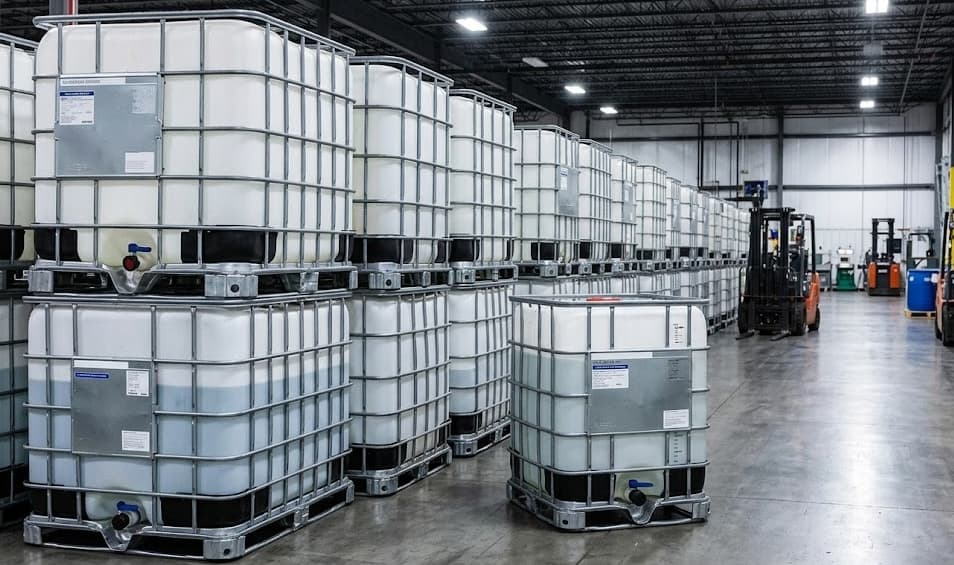
IBC Tote Recycling & Responsible Disposal
Every component of an IBC tote is recyclable. We disassemble, sort, and process HDPE, steel, and wood so nothing ends up in a landfill.
Get a Free Quote
Our 8-Stage Recycling Process
From the moment a tote leaves your facility to the moment its materials re-enter the manufacturing supply chain, every step is tracked, documented, and optimized for maximum recovery.
Collection & Intake
We pick up end-of-life IBC totes from your facility or accept drop-offs at any of our processing centers. Each container is logged, photographed, and assigned a tracking number so you can follow it through the recycling stream.
Hazard Assessment & Draining
Every tote is assessed for residual contents. Remaining product is drained into designated collection tanks. Hazardous residues are handled according to EPA and DOT protocols, with proper containment and documentation at every step.
Disassembly & Sorting
Trained technicians separate the three primary components: HDPE plastic bottles, galvanized steel cage frames, and wood or composite pallets. Valves, gaskets, and labels are also removed and sorted by material type.
Decontamination & Cleaning
Components that held food, chemical, or hazardous products undergo a thorough decontamination wash. This ensures that recyclable materials meet the purity standards required by downstream processors and eliminates cross-contamination risks.
HDPE Granulation
Plastic bottles are shredded, washed in a closed-loop water system, and processed into high-density polyethylene (HDPE) granules. These pellets re-enter the manufacturing supply chain as raw material for new containers, pipes, and industrial products.
Steel Recycling
Cage frames are cleaned, compressed into bales, and sent to steel mills for smelting. Recycled steel requires 74% less energy to produce than virgin steel, making this one of the highest-impact steps in our process.
Pallet Recycling
Wood pallets are inspected for reuse. Serviceable pallets are repaired and returned to the logistics cycle. Pallets beyond repair are chipped into mulch, animal bedding, or biomass fuel -- nothing goes to waste.
Accessory & Residual Processing
Valves, gaskets, caps, labels, and adhesive residues are sorted into secondary material streams. Polypropylene valves go to specialty plastics recyclers, rubber gaskets are processed for rubber crumb, and label stock is sent to waste-to-energy facilities.
Materials Recovery Rates
We made a commitment in 2019 that no IBC tote entering our facilities would end up in a landfill -- and we have maintained a 100% diversion rate ever since. Every material stream has a destination: HDPE becomes granules, steel goes to smelters, wood becomes mulch or biomass fuel, and even rubber gaskets and polypropylene valves are processed by specialty recyclers.
Our aggregate recovery rate across all material types is 95%. The remaining 5% consists of adhesive residues and heavily contaminated material that goes to licensed waste-to-energy facilities rather than landfill, maintaining our zero-landfill commitment.
Material Recovery Breakdown
Recovery rates based on aggregate data from all processing facilities for the trailing 12 months.
What Happens to Each Component
Every material in an IBC tote has a defined recycling pathway. Here is exactly where each component goes after disassembly.
HDPE Plastic Bottle
~18 kg per tote | 98% recovery rate
Process: Shredded into flakes, washed in closed-loop system, melted and extruded into pellets.
Becomes: New IBC bottles, HDPE pipes, drainage fittings, plastic lumber, recycling bins, and industrial containers.
Galvanized Steel Cage
~12 kg per tote | 99% recovery rate
Process: Cleaned, de-rusted, compressed into bales, and shipped to steel mills for electric arc furnace smelting.
Becomes: New cage frames, rebar, structural steel, automotive parts, and appliance components.
Wood / Composite Pallet
~6 kg per tote | 92% recovery rate
Process: Inspected for reuse potential. Repairable pallets are refurbished. Beyond-repair pallets are chipped.
Becomes: Reused pallets, landscape mulch, animal bedding, particle board, and biomass fuel for power generation.
Butterfly Valves
~0.5 kg per tote | 87% recovery rate
Process: Disassembled, sorted by material type (polypropylene body, EPDM gasket, stainless-steel handle).
Becomes: Polypropylene goes to plastics recyclers. Steel parts go to metal scrap. Gaskets go to rubber crumb processors.
Caps & Lids
~0.3 kg per tote | 95% recovery rate
Process: Sorted by resin type (HDPE or polypropylene), cleaned, and shredded with the corresponding material stream.
Becomes: Recycled plastic pellets for injection molding applications.
Labels & Adhesives
~0.1 kg per tote | 78% (energy recovery) recovery rate
Process: Scraped and dissolved during the decontamination wash. Collected as sludge and dewatered.
Becomes: Waste-to-energy incineration with energy recovery. Ash is processed per EPA guidelines.
Recycling vs. Landfill: Environmental Comparison
When an IBC tote is recycled instead of landfilled, the environmental benefits are significant and measurable. Here is a per-tote comparison based on our actual processing data.
| Environmental Metric | Landfill Disposal | Our Recycling Process | Net Benefit |
|---|---|---|---|
| CO2 Emissions | 38 kg released | 13 kg released | 25 kg CO2 prevented |
| HDPE Recovery | 0 kg recovered | 17.6 kg recovered | 17.6 kg plastic saved |
| Steel Recovery | 0 kg recovered | 11.9 kg recovered | 11.9 kg steel saved |
| Energy Consumption | 0 kWh (buried) | 8.5 kWh processing | 62 kWh virgin production avoided |
| Water Usage | Leachate risk | 15 gallons (closed-loop) | Groundwater contamination prevented |
| Landfill Space | 1.2 cubic meters | 0 cubic meters | 1.2 m3 landfill space saved |
| Decomposition Time | 450+ years (HDPE) | Immediate reprocessing | Centuries of pollution prevented |
Data represents per-tote averages for standard 275-gallon composite IBC totes based on lifecycle analysis conducted across our processing network.
The Numbers Behind Our Commitment
We track every kilogram of material that passes through our facilities. These cumulative figures represent real environmental outcomes, not estimates.
1,247,000+
IBC Totes Recycled to Date
12,400+
Tons Diverted from Landfill
47,000+
Metric Tons CO2 Prevented
95%
Average Material Recovery Rate
Per-Tote Impact
- 25 kg CO2 emissions prevented
- 18 kg HDPE plastic recovered
- 12 kg steel recycled
- 6 kg wood repurposed
Energy Savings
- 74% less energy vs. virgin steel
- 88% less energy vs. new HDPE production
- Closed-loop water systems cut usage 80%
- Solar-powered processing at 2 facilities
Compliance & Reporting
- Certificate of Recycling for every batch
- EPA-compliant disposal procedures
- DOT-certified hazmat handling
- Detailed sustainability reports on request
Compliance & Documentation
Proper disposal and recycling of IBC totes is not just good business -- it is a legal requirement in many jurisdictions. We ensure that every tote processed through our facilities complies with federal, state, and local environmental regulations, and we provide the documentation to prove it.
Our compliance team stays current with EPA Resource Conservation and Recovery Act (RCRA) requirements, DOT hazardous materials transportation regulations, and state-specific environmental mandates. When regulations change, our processes are updated immediately.
EPA Compliance
All recycling operations comply with RCRA Subtitle C and D requirements for hazardous and non-hazardous waste. Hazmat containers receive additional decontamination per 40 CFR 261 standards.
DOT Certification
Transportation of used and contaminated IBC totes follows DOT 49 CFR regulations. Our drivers are hazmat-certified and our vehicles carry appropriate placarding and spill kits.
State Environmental Permits
Every processing facility operates under the required state environmental permits for waste processing, water discharge, and air emissions.
OSHA Safety Standards
Our facilities maintain full OSHA compliance for worker safety, including hazard communication, PPE requirements, and confined space protocols.
Chain of Custody Tracking
Every IBC tote receives a unique tracking number at intake. This number follows the tote through every stage of the recycling process, creating an auditable chain of custody from your facility to the final recycled product. You can request a chain-of-custody report at any time.
Recycling Certificates
Every batch of recycled totes receives a formal Certificate of Recycling. This document serves as proof of responsible disposal for your environmental compliance records, audits, and corporate sustainability reporting.
Each certificate includes the total number of totes processed, material weights by type (HDPE, steel, wood), the name and certification of downstream recyclers, the date of processing, and the environmental impact data (CO2 prevented, materials recovered). Certificates are issued within 5 business days of processing completion and can be delivered electronically or as signed hard copies.
Industrial Waste Reduction Programs
Beyond one-time recycling pickups, we offer structured waste reduction programs for manufacturers, distributors, and facilities that generate ongoing IBC tote waste streams.
Scheduled Recycling Program
Set up weekly, bi-weekly, or monthly recycling pickups that run automatically. No need to call each time -- we arrive on schedule, collect your end-of-life totes, and process them through our zero-landfill system. You receive monthly sustainability reports and annual certificates.
- Automated recurring pickups
- No-call scheduling once set up
- Monthly impact dashboard
- Volume-based pricing locked annually
Zero-Waste Certification Support
Working toward zero-waste certification for your facility? We help you get there. Our recycling program provides the documentation, material tracking, and diversion rate data needed to support TRUE, UL, or NSF zero-waste certification applications.
- Detailed material diversion reports
- Chain-of-custody documentation
- Waste audit support and consultation
- Third-party recycler verification letters
Closed-Loop Supply Chain
For businesses that both purchase and dispose of IBC totes, we create a true closed loop. We supply cleaned, reconditioned totes for your operations and take back the used ones for recycling or re-reconditioning. One partner, zero waste, simplified logistics.
- Supply and take-back in one program
- Net-cost billing (buy-back credits offset purchases)
- Single monthly invoice
- Sustainability report for ESG reporting
Multi-Site Consolidation
If your company operates multiple facilities generating tote waste, we consolidate all locations under a single program. One contract, one account manager, one set of reports -- regardless of how many sites you operate across the country.
- Nationwide multi-site coverage
- Centralized reporting and billing
- Site-specific pickup schedules
- Single point of contact for all locations
Recycling FAQ
Do you really recycle 100% of every tote? What about the non-recyclable parts?
Yes, 100% of every tote is diverted from landfill. The 95% recovery rate represents materials that are directly recycled into new products. The remaining 5% -- primarily adhesive residues and heavily contaminated material -- goes to licensed waste-to-energy facilities where it is incinerated with energy recovery. Nothing reaches a municipal landfill.
Can you recycle totes that previously held hazardous materials?
Absolutely. We are fully equipped and permitted to handle totes that contained hazardous materials. These totes undergo an additional decontamination stage before material separation. All hazmat handling follows EPA RCRA and DOT regulations, and you receive a Certificate of Recycling that documents proper disposal.
How do I receive my Certificate of Recycling?
Certificates are issued within 5 business days of processing completion. By default, we email a PDF version to the contact on file. If you need a signed hard copy, we will mail one at no extra charge. Certificates include tote counts, material weights, downstream recycler information, and environmental impact data.
What is the minimum quantity for recycling pickup?
There is no hard minimum. We recycle as few as one tote. However, pickups of 10 or more totes are more cost-effective due to logistics efficiency. For very small quantities, you are also welcome to drop off totes at any of our processing centers at no charge.
Can recycling be combined with your buy-back program?
Yes, and this is actually how most businesses use our services. When we pick up a batch of totes, we grade each one on-site. Totes in reusable condition enter the buy-back program (you get paid), while totes beyond repair are routed to recycling. You receive both a buy-back payment and a Certificate of Recycling in one seamless process.
How does your recycling program support my company's ESG and sustainability reporting?
We provide detailed sustainability impact reports with every recycling order. These reports include total CO2 prevented, water saved, materials diverted from landfill, and energy savings compared to virgin material production. The data is formatted for easy integration into ESG reports, CDP disclosures, and corporate sustainability frameworks. We also provide letters of verification that third-party auditors can use to validate your claims.
Have IBC Totes That Need Recycling?
Whether you have 10 totes or 10,000, we will handle pickup, processing, and provide a Certificate of Recycling for your records.