Frequently Asked Questions
Answers to the most common questions about IBC totes, our services, grading, pricing, and more. Can't find what you need? Contact our team directly.
Get a Free Quote
IBC Tote Questions & Answers
We have compiled answers to over 30 of the most frequently asked questions about IBC totes, our reconditioning process, pricing, shipping, and compliance. Click any question to expand the answer.
What is an IBC tote?
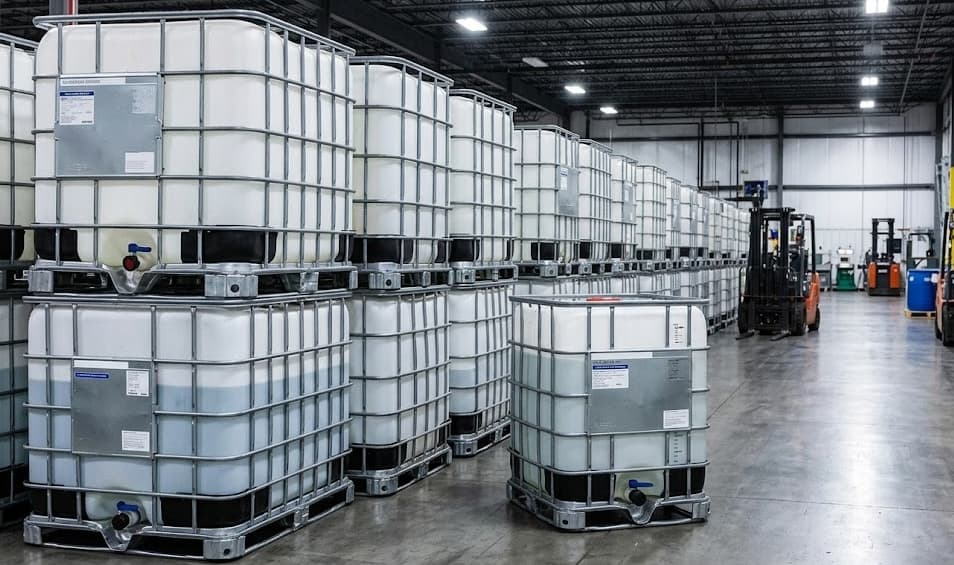
An IBC tote (Intermediate Bulk Container) is a reusable industrial container designed for the storage and transport of bulk liquids and granular materials. A standard IBC tote consists of three main components: a blow-molded high-density polyethylene (HDPE) inner bottle, a welded steel cage that provides structural support and protection, and a pallet base (wood, plastic, or steel) that allows handling with forklifts and pallet jacks. The most common size is 275 gallons (1,040 liters), though 330-gallon and 550-gallon models are also available. IBC totes are used across dozens of industries including chemical manufacturing, food and beverage, agriculture, pharmaceuticals, and construction.
How are reconditioned IBC totes cleaned?
Our reconditioning process is a multi-step procedure designed to restore totes to a high standard of cleanliness and functionality. First, all remaining contents are drained and properly disposed of. The tote is then pressure-washed with heated water (160–180°F) using rotating spray heads that reach every interior surface. Depending on the previous contents, we use food-safe detergents, alkaline degreasers, or specialized neutralizing solutions. After washing, the tote is triple-rinsed with clean water, and rinse water is tested to confirm cleanliness. For food-grade totes, an additional sanitization step meets FDA/USDA standards. Finally, each tote is inspected for structural integrity, the valve and cap are tested or replaced, and old labels are removed. The entire process uses our closed-loop water recirculation system, which reduces water consumption by approximately 80% compared to traditional methods.
What grades of IBC totes are available?
We offer three grades of reconditioned IBC totes. Grade A (Like New) totes have clean, clear bottles with no staining, straight cages with no rust, and new or near-new valves — these are suitable for food-grade applications and cost 40–60% less than new. Grade B (Good Condition) totes may have light staining or minor cosmetic cage imperfections but are structurally perfect for industrial chemical, agricultural, and manufacturing use at 55–75% savings. Grade C (Economy) totes show noticeable wear but remain fully functional, ideal for waste collection, rainwater harvesting, and DIY projects at 70–85% below new prices. We also carry brand-new IBC totes for customers who require them.
Do you offer nationwide shipping?
Yes, we ship IBC totes to all 50 states. We operate our own dedicated fleet for regional deliveries in the Midwest, and we partner with trusted national carriers for long-distance shipments. For bulk orders (10+ totes), we offer competitive full-truckload (FTL) rates that are often more cost-effective per unit. We can ship individual totes via LTL (less-than-truckload) freight as well. Typical transit times are 1–3 business days regionally and 3–7 business days nationally. We also offer free pickup for our buy-back program within our regional service area. Contact us for a shipping quote tailored to your location and quantity.
What is a food-grade IBC tote?
A food-grade IBC tote is manufactured from virgin HDPE resin that meets FDA 21 CFR 177.1520 standards, certifying it safe for direct contact with food products. Beyond the material itself, food-grade designation requires documented chain of custody showing that the tote has only ever contained food-safe substances. This means a tote that has held industrial chemicals can never be recertified as food-grade, regardless of how thoroughly it is cleaned — HDPE is slightly porous at the molecular level and can absorb trace chemicals permanently. Reconditioned food-grade totes must come with FDA compliance certificates, certificates of origin for the virgin resin, and chain of custody documentation. These are required for storing edible oils, syrups, juices, dairy products, potable water, and food-grade chemicals.
How many times can an IBC tote be reconditioned?
A well-maintained IBC tote can typically go through 3 to 5 reconditioning cycles before the HDPE bottle needs replacement. The steel cage and pallet base often last significantly longer — 10 to 15+ years with proper care. Several factors affect reconditioning life: the type of contents stored (aggressive chemicals reduce lifespan), UV exposure (outdoor storage accelerates degradation), physical handling (forklift damage, drops), and cleaning thoroughness between uses. Even when the bottle reaches end-of-life, it is removed and recycled into pellets for new plastic products, while the cage and pallet continue to be reused with a new bottle. This circular approach is what makes IBC tote recycling so environmentally impactful.
What sizes of IBC totes do you carry?
We stock three standard IBC tote sizes. The 275-gallon (1,040 liters) is the most common and widely available, measuring 48" L x 40" W x 46" H. The 330-gallon (1,250 liters) provides approximately 20% more capacity at the same footprint, measuring 48" L x 40" W x 53" H. The 550-gallon (2,082 liters) is a double-height unit at 48" L x 40" W x 67" H, used for high-volume static storage. All sizes share the standard 48" x 40" pallet base, making them compatible with standard forklifts, pallet jacks, and racking systems. The 275-gallon size has the greatest availability in both new and reconditioned options. Visit our Sizing Guide page for complete specifications and comparison data.
How does the buy-back program work?
Our buy-back program is simple and designed to put money back in your pocket while keeping totes out of landfills. Here is how it works: (1) Contact us with the quantity, size, grade, and location of your surplus totes. (2) We provide a competitive buy-back quote based on current market conditions and tote condition. (3) Once you accept, we schedule a pickup at your facility — free within our regional service area. (4) Our team inspects the totes on-site and loads them onto our trucks. (5) Payment is issued within 5–7 business days after pickup. We purchase totes in all conditions, from near-new to heavily used. Even totes that cannot be reconditioned have value as recycling feedstock. Minimum pickup is typically 10 totes, but we can accommodate smaller quantities in some areas.
What is your pricing for reconditioned IBC totes?
Pricing for reconditioned IBC totes varies based on grade, size, quantity, and current market conditions. As a general guide: Grade A (Like New) 275-gallon totes range from $120 to $200, Grade B (Good Condition) from $70 to $130, and Grade C (Economy) from $40 to $80. Food-grade reconditioned totes range from $150 to $250. Bulk discounts are available starting at 10 units, with significant volume pricing for orders of 50+ totes. New IBC totes are available from $250 to $450 depending on specifications. Shipping costs are additional and vary by location and quantity. We provide free, no-obligation quotes — contact us with your requirements for exact pricing.
Can I visit your facility?
Absolutely. We welcome customers, prospective buyers, and industry partners to tour our facility at 920 Blake Ave, South Milwaukee, WI 53172. During a visit, you can see our full reconditioning process in action — from receiving and inspection to washing, testing, grading, and staging for shipment. You can also inspect inventory firsthand and select specific totes for your order. We ask that you schedule your visit in advance so we can have a team member available to guide you. Please contact us by email at info@ibctotesrecycle.com or through our contact form to arrange a time. Safety gear (closed-toe shoes, safety glasses) is required on the production floor.
What are IBC totes made of?
An IBC tote has three primary components. The inner bottle is blow-molded from high-density polyethylene (HDPE), a thermoplastic known for excellent chemical resistance, durability, and recyclability. Wall thickness typically ranges from 2mm to 4mm. The cage is constructed from carbon steel tube or wire (8–11 gauge), welded in a grid pattern and finished with galvanized coating to resist corrosion. The cage provides structural support, stacking strength, and protection for the bottle. The pallet base comes in three options: wood (heat-treated per ISPM-15 for international shipping), HDPE plastic (preferred for food-grade and hygienic applications), or steel (most durable, used for heavy-duty and chemical environments). All three pallet types provide 4-way forklift entry and standard 48" x 40" dimensions.
How should I store IBC totes?
Proper storage extends tote life and maintains product integrity. Store IBC totes on a level, firm surface capable of supporting the full weight (up to 2,400+ lbs for a full 275-gallon tote). Indoor storage is preferred, as UV exposure degrades HDPE over time — if outdoor storage is unavoidable, use UV-resistant covers or wraps. Keep totes away from heat sources and open flames; HDPE has a maximum service temperature of approximately 150°F (65°C). Stack according to manufacturer guidelines: 2 high maximum when full for 275 and 330-gallon models, never stack 550-gallon totes when full. Close all valves and caps on empty totes to prevent contamination, pest intrusion, and rainwater accumulation. Rinse totes within 24 hours of emptying to prevent residue hardening. Conduct monthly visual inspections on stored totes and quarterly full inspections including valve testing and gasket checks.
Do you offer custom modifications?
Yes, we offer a range of custom modification services to adapt IBC totes to your specific requirements. Common modifications include: valve changes (upgrading to butterfly valves, camlock fittings, or stainless steel options), heating blanket installation for temperature-sensitive contents, custom fittings and adapters for specialized dispensing systems, secondary containment trays for hazardous materials, sight gauge installation for level monitoring, venting systems for products that generate gas, and custom labeling and color-coding for inventory management. Modifications can be performed on new or reconditioned totes. Lead times are typically 3–5 business days depending on complexity. Contact us with your specifications for a custom quote.
What happens to IBC totes that cannot be reconditioned?
We maintain a zero-landfill policy. When a tote reaches end-of-life and can no longer be reconditioned, every component is separated and recycled. The HDPE bottle is shredded and granulated into plastic pellets, which are sold to manufacturers of drainage pipes, landscape lumber, plastic sheeting, and other products. The steel cage is processed at metal recycling facilities where it is melted down and reused in new steel products. Wooden pallets are chipped for mulch, biomass fuel, or recycled into new pallet boards. Plastic pallets are granulated alongside the bottles. Valves, caps, and gaskets are sorted by material type (steel, HDPE, rubber) and recycled accordingly. This comprehensive approach ensures that 100% of every IBC tote is diverted from landfill, regardless of its condition when it arrives at our facility.
How do I prepare IBC totes for pickup?
Preparing your totes properly speeds up the pickup process and may improve your buy-back pricing. Here is what we recommend: (1) Drain all remaining contents and dispose of them properly according to local regulations. (2) Rinse the interior with water if possible — this is especially helpful for sticky or viscous residues. (3) Close the valve and cap securely to prevent leaks during transport. (4) Remove any custom fittings or accessories you want to keep. (5) Stack totes no more than 2 high to make loading easier. (6) Place totes in a location accessible by our truck (ideally near a loading dock or in a paved area with forklift access). (7) Have an approximate count ready and note any totes with known damage. You do not need to remove labels or perform deep cleaning — our facility handles all of that during the reconditioning process.
Can IBC totes be stacked when full?
Yes, but with important limitations. Standard 275-gallon and 330-gallon IBC totes are designed to be stacked a maximum of 2 high when full, provided the totes are in good structural condition with no bent or damaged cage members. The bottom tote must be placed on a level, stable surface capable of supporting the combined weight (approximately 4,800 lbs for two full 275-gallon totes of water). The 550-gallon totes should never be stacked when full due to their height and weight. Empty totes can typically be stacked 3 high with proper bracing. Always verify the stacking rating on the data plate of your specific tote model before stacking. Damaged cages, corroded frames, or warped pallets significantly reduce stacking safety and should not be stacked under load.
What is the weight capacity of an IBC tote?
The maximum gross weight (container plus contents) for a standard 275-gallon IBC tote is typically 2,200 to 2,500 lbs, as specified on the data plate. A 275-gallon tote filled with water weighs approximately 2,400 lbs (water weighs 8.34 lbs per gallon). For denser liquids, you must calculate whether the weight exceeds the maximum gross weight rating before the tote is full by volume. For example, a chemical with a specific gravity of 1.3 would weigh about 2,985 lbs in a full 275-gallon tote, which exceeds most maximum ratings — in this case, you would fill only to the weight limit, not the volume limit. The tare weight (empty tote) is typically 115-165 lbs for a 275-gallon model. Always check the specific data plate on your tote for the exact maximum gross weight rating.
How long do reconditioned totes last?
The service life of a reconditioned IBC tote depends on several factors including the grade, how it is used, and storage conditions. A Grade A reconditioned tote that stores non-aggressive liquids indoors can typically serve for 3 to 5 years before needing another reconditioning cycle. The HDPE bottle itself usually supports 3 to 5 reconditioning cycles over a total lifespan of 10 to 15 years. The steel cage and pallet base last even longer — often 15 to 20 years with proper care. Factors that reduce lifespan include storing aggressive chemicals (strong acids, oxidizers, aromatic solvents), prolonged UV exposure from outdoor storage, temperature extremes, and physical damage from rough handling. To maximize the life of your reconditioned totes, store them indoors or under cover, rinse promptly after emptying, and inspect regularly for signs of degradation.
Do you offer financing or payment plans?
We understand that large bulk orders represent a significant investment, so we offer several flexible payment options to accommodate different business needs. For orders of 50+ totes, we can arrange net-30 payment terms for qualified businesses with approved credit. For very large fleet purchases (100+ totes), we offer customized payment schedules that can be structured over 60 or 90 days. We accept all major credit cards, ACH bank transfers, wire transfers, and company checks. For government agencies and large corporations, we can accommodate purchase order (PO) processes. We do not currently offer traditional financing or lease-to-own programs, but our reconditioned totes already represent 40–85% savings compared to new, making them an extremely cost-effective option. Contact our sales team to discuss payment terms for your specific order.
Can I mix chemicals in an IBC tote?
We strongly advise against mixing chemicals in an IBC tote unless you have verified the compatibility of all substances involved and have proper safety protocols in place. Chemical mixing can generate heat, toxic gases, pressure buildup, or violent reactions depending on the compounds involved. If you need to blend or mix chemicals, ensure that: (1) all chemicals are verified as compatible with each other and with HDPE, (2) the reaction is well-understood and documented, (3) proper ventilation is in place, (4) PPE appropriate to all chemicals is worn, (5) secondary containment is in place, and (6) you have an SDS (Safety Data Sheet) for each chemical and the resulting mixture. IBC totes used for mixing should be equipped with proper venting to prevent pressure buildup. Never add water to concentrated acids in an IBC tote — always add acid to water. When in doubt, consult a chemical engineer or safety professional before mixing any chemicals.
What is the difference between HDPE and PP totes?
HDPE (High-Density Polyethylene) and PP (Polypropylene) are both thermoplastic polymers used in IBC tote construction, but they have different properties that make each suited to different applications. HDPE is the most common material for IBC totes and offers excellent chemical resistance to most acids, bases, and solvents, good impact resistance (especially at low temperatures), and is FDA-approved for food contact. PP totes offer superior resistance to higher temperatures (up to 230°F / 110°C versus 150°F / 65°C for HDPE), better resistance to certain organic solvents and oxidizing chemicals, and higher rigidity. However, PP is more brittle at low temperatures and less impact-resistant than HDPE. The vast majority of IBC totes on the market are HDPE, and PP totes are typically used only when specific chemical compatibility or temperature requirements demand it. Always verify material compatibility with your specific chemical before purchasing.
Are your totes DOT compliant?
Yes, we carry DOT-compliant IBC totes for the transport of hazardous materials. DOT compliance requires that the tote meets UN performance standards (typically UN 31HA1 for composite IBCs with a rigid outer packaging), is within its allowed service life, and carries the proper UN markings on the data plate. For new totes, the DOT service life is 5 years from the date of manufacture. For reconditioned totes, the service life is 2.5 years from the date of reconditioning, or 5 years from the original manufacture date, whichever comes first. Our reconditioned DOT-compliant totes are inspected to verify cage integrity, bottle condition, valve function, and data plate accuracy. We stamp the reconditioning date on each unit. If you need DOT-compliant totes, please specify this when requesting a quote so we can ensure your order meets all applicable 49 CFR requirements.
Can totes be used for drinking water?
IBC totes can be used for drinking water storage, but specific requirements must be met. The tote must be food-grade, meaning it is manufactured from virgin HDPE resin meeting FDA 21 CFR 177.1520 and has a documented chain of custody confirming it has never held non-food substances. A reconditioned tote can only be used for potable water if its entire history has been food-grade. For drinking water applications, we recommend new or Grade A food-grade totes with plastic pallets (to avoid any wood contamination). The tote should be thoroughly sanitized before first use, and the water should be treated with an appropriate disinfectant. Store the tote in a cool, shaded area to prevent algae growth and HDPE degradation. Be aware that HDPE can impart a slight plastic taste to water if stored for long periods, especially in warm conditions. For permanent potable water storage, dedicated water-rated tanks may be more appropriate than IBC totes.
What temperature range can IBC totes handle?
Standard HDPE IBC totes are rated for a service temperature range of approximately -40°F to 150°F (-40°C to 65°C). At temperatures above 150°F, HDPE begins to soften and the bottle can deform under the weight of the contents, potentially leading to failure. At extremely low temperatures, HDPE becomes more brittle and impact-sensitive, though it remains functional down to about -40°F. For hot-fill applications, the contents should not exceed 140°F at the time of filling to allow a safety margin. PP (Polypropylene) totes offer a higher temperature range, up to approximately 230°F (110°C), and are recommended when higher temperature resistance is needed. For temperature-sensitive products that must be kept warm during storage and transport, insulated blankets and heating jackets are available as accessories. Never expose an IBC tote to open flame or direct contact with heating elements.
How do I read the data plate on an IBC tote?
The data plate is a metal or embossed plate permanently attached to the IBC cage that contains critical identification and compliance information. Here is how to read the key markings: The UN symbol (a circle with "UN" inside) followed by the IBC code (e.g., 31HA1) indicates the container type and rating. The next line typically shows the test pressure, specific gravity rating, and maximum gross weight. The manufacturer code and country of origin identify who built the tote and where. The date of manufacture (month/year) is critical for DOT compliance — new totes are valid for 5 years from this date for hazmat use. If the tote has been reconditioned, a reconditioning date and reconditioner code will also be stamped on the plate. The serial number provides individual tote traceability. If any data plate information is illegible, damaged, or missing, the tote may not be compliant for DOT-regulated shipments. Our team can help you interpret data plate markings if needed.
Do you offer emergency or rush orders?
Yes, we understand that production schedules and urgent situations sometimes require fast turnaround. For customers in our regional service area (Wisconsin, Illinois, Indiana, Michigan, Minnesota, Iowa), we can often arrange same-day or next-day delivery from our in-stock inventory. For rush orders shipped nationally, we can prioritize order processing and work with expedited freight carriers to reduce transit times. Rush order availability depends on current inventory levels for the specific size, grade, and configuration you need — standard 275-gallon Grade B and Grade C totes have the highest likelihood of immediate availability due to our large stock levels. Rush orders may incur expedited processing and/or shipping surcharges. To request a rush order, call our team directly or note the urgency in your contact form submission and we will prioritize your request.
What is the return policy?
We stand behind the quality of every tote we sell. If a tote arrives damaged during shipping, does not match the grade you ordered, or has a defect that was not disclosed at the time of sale, we will replace it or issue a full refund at your choice. Claims must be reported within 7 business days of delivery with photos of the issue. For undamaged totes that simply do not meet your needs, we accept returns within 14 days of delivery provided the totes are in the same condition as received and have not been filled. Return shipping costs are the buyer’s responsibility for non-defective returns. For bulk orders, we can arrange for our buy-back program to repurchase totes at market rates if your needs change after taking delivery. We always recommend inspecting your order upon arrival and reporting any concerns immediately so we can resolve them quickly.
Can I customize the valve type?
Absolutely. We offer a full range of valve options to match your specific dispensing and transfer requirements. Standard options include: 2-inch polypropylene butterfly valve (the industry standard, included on most totes), 2-inch nylon butterfly valve (higher strength), 3-inch butterfly valve (for higher flow rates or viscous liquids), stainless steel butterfly valve (for corrosive chemicals or food-grade applications), 2-inch ball valve (for precise flow control), camlock fittings in various sizes (for quick-connect hose attachment), and threaded adapters for specialized connections. We can also install combination setups — for example, a butterfly valve with a camlock adapter. Valve changes can be performed on new or reconditioned totes at our facility. Lead time for valve customization is typically 1-3 business days. Specify your preferred valve type when placing your order, or contact us for recommendations based on your application.
How do I calculate how many totes I need?
Calculating your IBC tote requirements depends on your total volume needs, fill/empty frequency, and desired reserve capacity. Start with this formula: Number of totes = (Total liquid volume in gallons) divided by (Tote capacity in gallons). For a 275-gallon tote, that is your total volume divided by 275. However, you should also factor in: (1) Cycle time — if you fill and empty totes regularly, you need enough to cover your production cycle plus transit time. (2) Safety stock — most operations keep 10–20% extra totes as buffer. (3) Maintenance rotation — totes periodically need cleaning or inspection, so plan for 5–10% to be out of service at any time. (4) Growth projections — if your volume is increasing, order for 6–12 months ahead. Example: A company using 5,000 gallons per week with a 2-week supply cycle needs 5,000 x 2 = 10,000 gallons, divided by 275 = 37 totes, plus 20% buffer = 44 totes. Our team can help you calculate the exact number for your specific operation.
What is the shelf life of an IBC tote?
The shelf life of an IBC tote depends on whether you are asking about the container itself or the DOT compliance period. For the physical container: an HDPE bottle stored indoors and protected from UV exposure can remain serviceable for 10 to 15 years across multiple reconditioning cycles. The steel cage and pallet base can last 15 to 20+ years with proper care. For DOT compliance: new totes are rated for 5 years from the date of manufacture for transporting hazardous materials. Reconditioned totes are rated for 2.5 years from the reconditioning date for hazmat transport. After the DOT compliance period expires, the tote can still be used for non-DOT-regulated storage and transport as long as it passes visual inspection. For contents shelf life: the stability of your stored product depends on the product itself, not the tote. However, HDPE can absorb and transfer trace odors over very long storage periods, and UV exposure can accelerate degradation of certain photosensitive products. Always consult your product specifications for contents shelf life guidance.
What is the environmental impact of using reconditioned totes?
Choosing reconditioned IBC totes over new ones has a significant positive environmental impact. Manufacturing a new 275-gallon IBC tote requires approximately 60-80 lbs of virgin HDPE resin (derived from petroleum), 80-100 lbs of new steel, and substantial energy for molding, welding, and assembly. By reconditioning and reusing existing totes, we avoid this entire manufacturing footprint. Our data shows that each reconditioned tote saves approximately: 60-80 lbs of virgin plastic, 80-100 lbs of virgin steel, 1,200 gallons of water (compared to new manufacturing), 150-200 kWh of energy, and approximately 250-350 lbs of CO2 emissions. Over a typical 3-5 reconditioning cycle life, a single tote prevents 750-1,750 lbs of CO2 emissions compared to using new containers each time. Our closed-loop water system reduces reconditioning water usage by 80%, and our zero-landfill policy ensures that 100% of end-of-life totes are recycled rather than sent to landfill.
Do you provide certificates of cleaning or compliance documentation?
Yes, we provide documentation appropriate to the grade and application of each tote. For food-grade totes, we supply FDA compliance certificates, certificates of origin for the virgin HDPE resin, and chain-of-custody documentation verifying that the tote has only contained food-safe substances. For DOT-compliant totes, we provide reconditioning certificates with the date of reconditioning, reconditioner identification, and confirmation that the tote meets UN performance standards. For all reconditioned totes, we can provide a certificate of cleaning that describes the cleaning process used and confirms the tote passed our quality inspection. For pharmaceutical and specialty applications, we can accommodate specific documentation requirements including batch-level cleaning records and test results. If you need specific documentation for your quality management or regulatory compliance system, let us know when placing your order and we will ensure the appropriate paperwork is included.
IBC Tote Specifications at a Glance
A side-by-side comparison of key specifications for the three most common IBC tote sizes.
| Specification | 275 Gallon | 330 Gallon | 550 Gallon |
|---|---|---|---|
| Capacity (liters) | 1,040 L | 1,250 L | 2,082 L |
| Dimensions (L x W x H) | 48" x 40" x 46" | 48" x 40" x 53" | 48" x 40" x 67" |
| Tare Weight (empty) | 115-145 lbs | 130-165 lbs | 180-220 lbs |
| Max Gross Weight | ~2,500 lbs | ~3,000 lbs | ~5,000 lbs |
| Pallet Size | 48" x 40" | 48" x 40" | 48" x 40" |
| Stacking (full) | 2 high max | 2 high max | Do not stack |
| Standard Valve | 2" butterfly | 2" butterfly | 2" butterfly |
| Temperature Range | -40 to 150 F | -40 to 150 F | -40 to 150 F |
| DOT Life (new) | 5 years | 5 years | 5 years |
Reconditioned Tote Pricing Guide
General pricing ranges for 275-gallon IBC totes. Actual pricing varies based on quantity, market conditions, and specific requirements. Contact us for an exact quote.
| Grade | Price Range | Savings vs New | Best For |
|---|---|---|---|
| Grade A (Like New) | $120 - $200 | 40-60% | Food-grade, premium industrial |
| Grade B (Good) | $70 - $130 | 55-75% | Chemical, agriculture, manufacturing |
| Grade C (Economy) | $40 - $80 | 70-85% | Waste collection, rainwater, DIY |
| Food-Grade Reconditioned | $150 - $250 | 35-55% | Edible oils, juices, syrups, potable water |
| Brand New | $250 - $450 | N/A | Pharmaceutical, ultra-clean applications |
Bulk discounts available starting at 10 units. Volume pricing for orders of 50+ totes. Shipping costs additional. Contact us for exact pricing.
Explore More Resources
Dive deeper into IBC tote topics with our detailed guides and articles.
IBC Sizing Guide
Complete dimensions, weight data, and specifications for 275, 330, and 550 gallon totes.
IBC Grades Explained
Detailed breakdown of Grade A, B, C and food-grade classifications with pricing and use cases.
Articles & Guides
In-depth articles on IBC tote maintenance, repurposing, environmental impact, and buying best practices.
Still Have Questions?
Our team is happy to answer any questions not covered here. Reach out and we will get back to you within one business day.