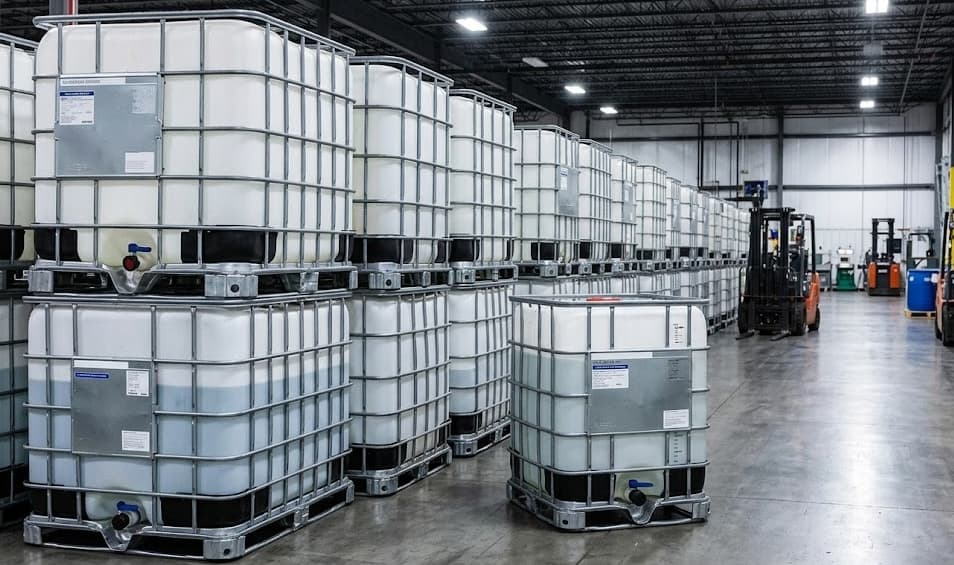
IBC Tote Transportation & Logistics
Nationwide pickup and delivery for IBC totes of every size and condition. Our dedicated fleet and partner network cover all 48 contiguous states.
Get a Free Quote
Our Fleet & Capabilities
We maintain a dedicated fleet purpose-built for IBC tote transportation. Every vehicle is equipped for safe, efficient handling of intermediate bulk containers -- whether empty, full, clean, or contaminated.
Flatbed Trailers
Open-deck flatbeds handle palletized IBC totes with forklift access from all sides. Capacity: up to 20 standard totes per load.
Enclosed Box Trucks
Protect your totes from weather and road debris during transit. Ideal for reconditioned or food-grade containers. Capacity: 12-16 totes.
53-Foot Dry Vans
Maximum capacity for bulk shipments. Double-stacked loading fits up to 40 empty totes or 20 full containers per trailer.
Forklift-Equipped Trucks
Our trucks carry mounted forklifts for loading and unloading at facilities without dock access or on-site equipment.
Vehicle Specifications
Each vehicle in our fleet is purpose-selected for IBC tote transport. Here are the detailed specifications so you can plan your shipments with confidence.
| Vehicle Type | Deck Length | Empty Tote Capacity | Full Tote Capacity | Forklift Equipped | Enclosed |
|---|---|---|---|---|---|
| Standard Flatbed | 48 ft | 20 | 20 | -- | |
| Enclosed Box Truck (26 ft) | 26 ft | 16 | 12 | ||
| 53-Foot Dry Van | 53 ft | 40 (double-stacked) | 20 | -- | |
| Straight Truck (16 ft) | 16 ft | 8 | 6 | ||
| Step Deck Trailer | 48 ft | 24 (double-stacked) | 20 | -- | -- |
Load Planning Guide
Efficient load planning saves you money. Here is how to calculate how many totes fit on each truck type and what to consider when planning your shipment.
Standard 275-Gallon Tote Dimensions
A standard composite IBC tote measures approximately 48 inches long x 40 inches wide x 46 inches tall (including pallet). Each unit weighs about 130 lbs empty and up to 2,200 lbs full.
Single-Layer Loading
On a 48-foot flatbed, 20 standard totes fit in a single layer (5 across x 4 deep). This is the standard method for full or heavy totes where stacking is not recommended.
Double-Stacking (Empty Totes Only)
Empty totes can be safely double-stacked in enclosed trailers, doubling capacity to 40 units on a 53-foot dry van. Stacking is secured with load bars and strapping.
Mixed Loads
We routinely combine empty and full totes on the same load, optimize palletized vs. non-palletized configurations, and coordinate multi-stop routes for maximum efficiency.
Weight Considerations
Federal weight limits cap most loads at 44,000 lbs of freight. For full 275-gallon totes at ~2,200 lbs each, this means approximately 20 totes per trailer regardless of physical space.
Quick Capacity Reference
1-2
Tote Minimum
40
Totes Max per Trailer
48
States Covered
98%
On-Time Delivery Rate
From One Tote to a Full Truckload
Not every operation needs a full trailer. We handle shipments of all sizes -- from a single surplus tote at a small facility to recurring weekly pickups of 200+ containers at a large manufacturing plant. Our logistics team optimizes routing and load planning to keep your per-unit costs as low as possible.
Single-Unit Pickup
Have just one or two totes? We consolidate single-unit pickups along existing routes so you still get competitive rates without a minimum order.
Partial Loads (3-19 Totes)
Mid-volume shipments are grouped with nearby pickups on shared trailers, reducing cost per tote while maintaining reliable schedules.
Full Truckloads (20+ Totes)
Dedicated trailer service with the lowest per-unit cost. Priority scheduling and direct-to-facility delivery without intermediate stops.
Recurring Contracts
Scheduled weekly or monthly pickups at a locked-in rate. Ideal for manufacturers and distributors with predictable tote turnover.
Freight Rate Factors
Transportation pricing depends on several variables. Understanding these factors helps you optimize costs and plan shipments more effectively.
Distance from Hub
Closer to our Midwest, Southeast, or West Coast hubs means lower freight rates. The primary driver of transportation cost is mileage.
Load Size & Density
Full truckloads cost less per tote than partial loads. Empty totes that can be double-stacked also reduce per-unit rates.
Tote Condition (Full vs. Empty)
Full totes are heavier and may hit weight limits before filling the trailer. Empty totes are lighter and allow more units per load.
Access Requirements
Facilities without loading docks require forklift-equipped trucks, which carry a small premium. Easy-access sites with dock doors get the best rates.
Scheduling Flexibility
Flexible pickup windows allow us to consolidate your shipment with nearby stops, reducing cost. Fixed-date requirements may limit consolidation options.
Hazmat Classification
Totes containing hazardous residue require placarded vehicles, certified drivers, and additional documentation, which adds to the freight rate.
Fuel Surcharge
A variable fuel surcharge is applied based on the DOE weekly diesel price index. This is standard across the freight industry and is clearly itemized on your invoice.
Route Coverage & Transit Times
Our service network spans all 48 contiguous states. Turnaround times depend on your distance from our primary hub and regional depots, but even the most remote locations are reachable within a week.
Midwest Hub
1-2 days typical transit
WI, IL, IN, MI, OH, MN, IA, MO
Headquartered in South Milwaukee, WI -- our fastest service area.
Southeast
2-3 days typical transit
GA, FL, SC, NC, TN, AL, MS, LA
Partner depots in Atlanta and Charlotte for rapid regional coverage.
Northeast
2-3 days typical transit
NY, NJ, PA, CT, MA, MD, VA, DE
High-density corridor with frequent scheduled routes.
Southwest
3-4 days typical transit
TX, OK, AR, NM, AZ
Dedicated Texas routes running weekly from our Midwest hub.
West Coast
3-5 days typical transit
CA, OR, WA, NV, UT, CO
Partner network with staging areas in Los Angeles and Portland.
Plains & Mountain
4-5 days typical transit
NE, KS, SD, ND, MT, WY, ID
On-demand scheduling with consolidated routing for cost efficiency.
How Scheduling Works
Submit Your Request
Tell us quantity, location, and preferred dates via form, phone, or email.
Receive Confirmation
Our logistics team confirms the pickup window within 2 hours during business days.
Track in Real Time
Receive a tracking link with driver ETA, live GPS location, and estimated arrival.
Loading & Departure
Our crew handles all loading. You receive a signed Bill of Lading and photo documentation.
Delivery Confirmation
Automated notification when your totes arrive at their destination, with proof of delivery.
Book, Track, Done
Scheduling a pickup or delivery takes minutes. Our logistics coordinators handle all the details -- route planning, driver assignment, load optimization, and communication -- so you can focus on running your business.
Need to reschedule? No problem. We offer free rescheduling with 24-hour notice. Our flexible approach means your supply chain stays agile even when plans change.
- Online scheduling form available 24/7
- Phone and email booking during business hours
- Weekend and after-hours pickup available
- Free rescheduling with 24-hour notice
- Automated email and SMS status updates
Insurance & Liability Coverage
Every shipment we handle is fully insured from the moment our crew begins loading until delivery is confirmed at the destination. We carry comprehensive coverage that protects your cargo against damage, loss, and transit-related incidents.
Cargo Insurance
All shipments are covered by cargo insurance up to $100,000 per load. This covers damage or loss during transit, loading, and unloading. Higher coverage limits are available for high-value shipments on request.
General Liability
We carry $2 million in general liability coverage that protects your property during on-site loading and unloading operations. Our crew is trained in safe handling practices.
Workers Compensation
All drivers and loading crew are covered by workers compensation insurance. You are never liable for injuries sustained by our team on your property.
Environmental Liability
Our pollution liability coverage protects against spills or releases during transport of containers with residual contents. This includes cleanup costs and third-party claims.
Claims Process
In the rare event of cargo damage, our claims process is straightforward. File a claim within 48 hours of delivery, provide photos and documentation, and receive resolution within 10 business days.
Hazmat Transport
IBC totes that previously held hazardous materials require specialized transport procedures. We are fully equipped and permitted to handle hazmat shipments in compliance with DOT 49 CFR regulations.
- CDL drivers with hazmat endorsement (HME)
- DOT-compliant placarding and labeling
- Spill containment kits on every vehicle
- Emergency response plans filed with LEPC
- Shipping papers and manifests prepared by our team
- Registered with PHMSA for hazmat transport
- 24/7 emergency response hotline
Cross-Border Shipping (US-Canada)
We are actively expanding cross-border IBC tote transport between the United States and Canada. Currently available for select routes with growing coverage.
- Ontario and Quebec routes available now
- British Columbia and Alberta routes in development
- Customs brokerage coordination included
- CBSA and CBP documentation prepared by our team
- Bonded carrier status for cross-border moves
- CTPAT (Customs-Trade Partnership Against Terrorism) certified
Transportation FAQ
Do I need a loading dock for pickup?
No. Many of our trucks carry mounted forklifts specifically for facilities without dock access. Our crew can load totes from ground level, warehouse floors, or outdoor staging areas. All we need is reasonable forklift clearance (approximately 12 feet of vertical clearance and 10 feet of aisle width).
Can you transport full (liquid-filled) IBC totes?
Yes. We transport both empty and full IBC totes. Full totes are secured with additional strapping and blocking to prevent shifting during transit. Weight limits apply -- a standard trailer can carry approximately 20 full 275-gallon totes before hitting the federal gross weight limit. Totes with hazardous contents require placarded vehicles and hazmat-certified drivers.
How is transportation priced?
Pricing is based on distance, load size, tote condition (full vs. empty), access requirements, and scheduling flexibility. Full truckloads receive the lowest per-unit rate. We provide detailed, itemized quotes before scheduling so there are no surprises. Fuel surcharges are applied based on the DOE weekly diesel index.
What is your on-time delivery rate?
Our on-time delivery rate is 98% across all shipments. We define on-time as arriving within the confirmed delivery window. In the rare case of a delay (weather, mechanical issue, etc.), we proactively notify you with an updated ETA and work to minimize impact on your operations.
Can you coordinate multi-stop routes across several of my facilities?
Absolutely. Multi-stop routes are one of our specialties. We plan efficient routing across multiple pickup or delivery locations, consolidating everything into a single shipment with one Bill of Lading. This is especially cost-effective for businesses with tote inventory spread across several warehouses, plants, or distribution centers.
Do you offer transportation as a standalone service, or only with cleaning/recycling?
Transportation is available as a fully standalone service. While many customers combine transport with cleaning, recycling, or buy-back services, you can also use us purely for IBC tote logistics -- moving totes between your own facilities, to third-party locations, or anywhere else they need to go.
Need IBC Totes Picked Up or Delivered?
Get a free transportation quote today. Tell us the quantity, location, and timeline, and we will handle the rest.